
Dr. Fabian M. Dayrit
Professor, Department of Chemistry, Ateneo de Manila University
Former President of the ICP, 1996 – 2025
This year, 2026, marks the 50th year of the Integrated Chemists of the Philippines (ICP). This essay gives a brief history of the ICP, including key organizations and events in the history to the ICP.
The first national Philippine chemical society was formally established as the Chemical Society of the Philippines (CSP)1 in 1937. The membership of the CSP came mainly from the academe and government agencies. In 1952, Congress passed the Republic Act No. 754 (known as the “Chemistry Law of the Philippines”) which sought to regulate the professional practice of chemistry in the Philippines. RA 754 defined a Chemist as: “Any person, who for fee, salary or other compensation or reward to himself or to another person renders professional service requiring the use and application of chemical knowledge, and/or chemical or physico-chemical processes.” The law also created the Board of Examiners for Chemists and required chemists to register with the Board to practice chemistry. The first members of the Board were Benito F. Legarda (Chairman), and Eduardo Taylor and Marcos Alicante (Members). RA 754 required an examination which included General Chemistry, Analytical Chemistry, Industrial Chemistry, Allied Subjects, and areas of Specialization. The scope of the licensure examination was revised through the years. RA 754 focused mainly on the qualifications of the professional chemist and it defined the professional practice of chemistry in the Philippines until 2015 when it was replaced by RA 10657.
As the chemical sciences branched out into various subdisciplines, so too were specialized chemistry-related societies created. In addition to the CSP (later renamed KKP), the following societies were established: Philippine Association of Chemistry Teachers (PACT) (1961), the Philippine Association of Chemistry Students (PACS) (1964), Organic Chemistry Teachers Association (OCTA) (1971), and the Philippine Biochemistry Society (PBS) (1973)2.
Although the professional chemist was defined by RA 754 in 1952, their home organization remained the KKP until 1976 when the organization of professional chemists was established following the mandate of then President Ferdinand Marcos, Sr. to integrate the various societies under a single organization. However, no such integration occurred among the chemistry societies. Instead, a new organization of professional chemists was created with the Integrated Chemists of the Philippines. The ICP was officially registered with the Securities and Exchange Commission on July 14, 1976.
During the 1980s, the ICP and KKP worked closely with shared officers, meetings and activities. Many of the monthly meetings were held at United Laboratories, hosted by the late Dr. Roger de Leon. In 1985, Dr. Benigno Peczon, who headed the analytical laboratory at Unilab, chaired the first Philippine Chemistry Congress which was held at St. Louis University, Baguio City. This successful congress led to the establishment of the Philippine Federation of Chemistry Societies (PFCS) in 1988 to unite the various chemical associations in the country. Currently, the members of the PFCS are the ICP, KKP, PACT, and PACS. Among its major activities are the traditional celebration of Chemistry Week during the 3rd week of February, the organization of the Philippine Chemistry Congress, the selection of outstanding chemists in various areas, and the organization of the Philippine Chemistry Olympiad, from which the Philippine representatives to the International Chemistry Olympiad are selected.
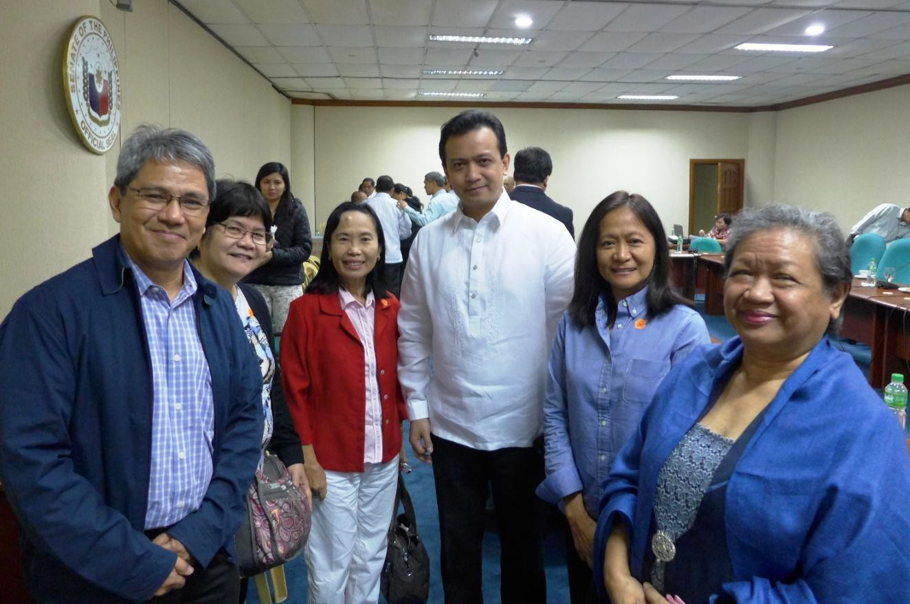
By the 1990s, it was felt that there was a need to revise RA 754 to make it more responsive to the needs of the chemistry profession. The first forum on the revision of RA 754 took place during the 14th Philippine Chemistry Congress in 1998. By 2005, fourteen drafts of proposed revisions had been prepared and presented to potential sponsors in the senate and congress. But it was only on March 27, 2015 when RA 10657 (known as the “Chemistry Profession Act”) was passed into law through the sponsorship in the Lower House by Congresswoman Victoria G. Noel and in the Senate by Senator Antonio F. Trillanes IV. Among the key revisions in RA 10675 are the following: the creation of the Chemistry Technician professional, requirement for continuing professional education (CPD), regulation and improvement of chemical laboratories, and introduction of legal protection and hazard pay for chemists and chemical technicians.
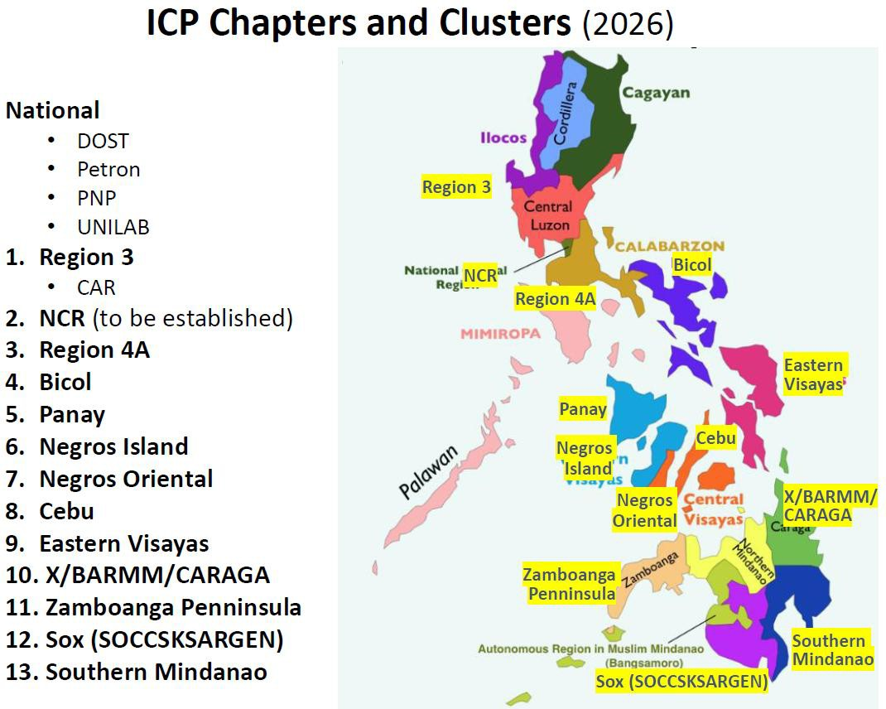
The ICP itself has indeed grown significantly. In 2018, a new ICP constitution was approved by the membership to match the changes brought about by RA 10675. From a single active board and membership of about 500 in the 1990s, the ICP has grown to over 4,000 members and the number of board examiners has likewise grown after the passage of RA 10657 in 2015. The ICP currently has 12 regional chapter. A 13th chapter, the NCR chapter, is being organized for 2026. This will enable the ICP National board to focus its attention on national matters and a NCR chapter to attend to local affairs.
Another important activity of the ICP is the annual National Conference of Chemical Laboratories (NCCL) which was spearheaded by Edna C. Mijares in 2017. The NCCL has become an annual meeting that is focused on the needs of chemical laboratories, including important topics such as chemical waste management, advances in analytical methodologies, laboratory management, relevant product standards, among others. NCCL will be holding its 10th session in February 2027.
As stated in the Declaration of Policy of RA 10657: “Chemistry is vital to public safety, the national economy, and the protection of the environment. It is, therefore, the policy of the State to promote, regulate and protect the professional practice of chemistry and to ensure the continued development and high international standards of the practice of chemistry in the Philippines.” Although this policy was explicitly enunciated in 2015, the ICP has been dedicated to this policy since its establishment fifty years ago in 1976.
1CSP was renamed as Kapisanang Kimika ng Pilipinas in the 1970s.
2PBS was renamed Philippine Society for Biochemistry and Molecular Biology (PSBMB) in 1993.